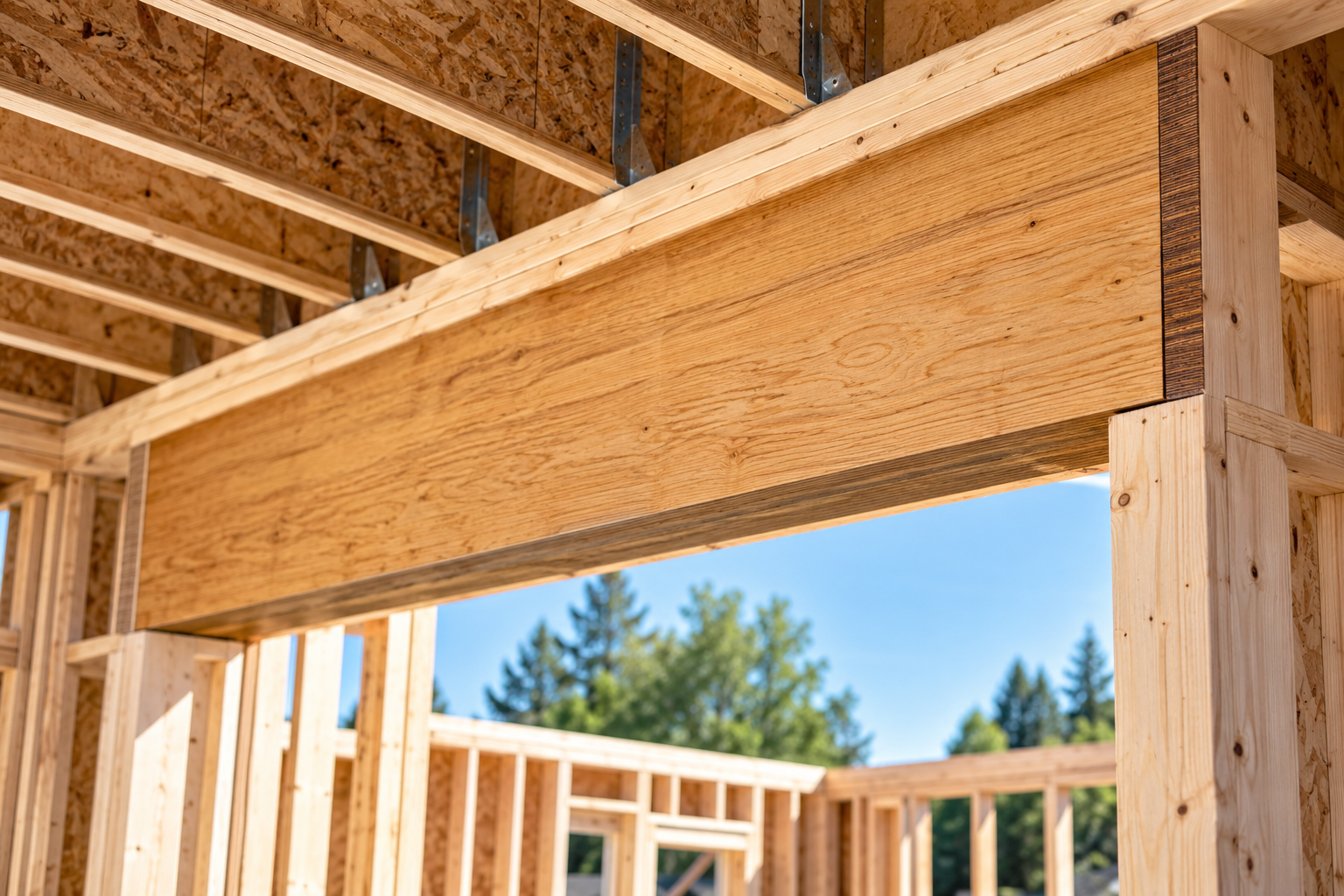
Beam selection in engineered wood doesn’t always come down to LVL or glulam. In some structural conditions, PSL or LSL may be the better fit — and that is where parallel-strand lumber and laminated-strand lumber become the better structural option.
PSL and LSL show up in structural roles that contractors and specifiers encounter more often than the product names might suggest. The post carrying a flush beam in a tight floor system, the column under a point load at a transfer, the header in a situation where depth is constrained and load is high — these are conditions where PSL and LSL are worth knowing. Knowing which one applies, and why, is what separates a clean structural solution from a field problem that shows up later.
What PSL Actually Is and Where It Comes From
Parallel-strand lumber is manufactured from long strands of wood fiber — typically veneer strands — that are oriented parallel to the length of the member and bonded under heat and pressure with waterproof adhesive. APA classifies PSL within the structural composite lumber family alongside LVL and LSL, but the strand geometry and manufacturing process give it a distinct performance profile.
The result is a dense, high-capacity member with high bending strength, high stiffness, and design values that can exceed solid sawn lumber of equivalent dimension by a significant margin. PSL generally offers consistent connection performance and is often preferred where connection demands are high — though connector design still has to follow manufacturer tables and engineering requirements, the same as any structural member.
The density that drives PSL’s performance also affects handling. PSL is a notably heavy product, and that matters in sequencing and in the math when the assembly has to carry its own dead load across a long span.
What LSL Actually Is and Where It Differs
Laminated-strand lumber uses shorter wood strands than PSL — typically cut from small-diameter or low-grade timber that would otherwise have limited structural value — bonded with adhesive and compressed into billets that are then cut to finished member sizes.
The strand geometry is the key difference from PSL. LSL strands are shorter and less uniformly oriented, which gives LSL lower bending strength and stiffness than PSL for the same member size. What LSL gives up in pure bending performance, it recovers in dimensional stability, consistent sizing, and value in applications where bending demand is moderate but dimensional precision and stability matter more than raw strength.
LSL is often favored in applications where dimensional stability and consistent sizing are major priorities. Where field drilling or notching is part of the assembly — wall studs through which trades need to run, for instance — LSL can be suitable, but any modification still has to stay within the manufacturer’s published limits for the specific product. Some LSL products allow holes within defined zones; others don’t. That determination comes from the product literature, not from the general LSL label.
The Core Difference: Where Each Product Earns Its Place
The manufacturing difference between PSL and LSL translates directly into a performance split.
PSL is the high-load product. It shows up where the engineer needs maximum bending capacity and stiffness in a given depth, or where the member is functioning as a post or column under significant axial load. When a project needs to carry a heavy point load from a ridge beam or a transfer condition, and the available member depth is constrained, PSL is often what the engineer reaches for.
LSL is the precision and stability product. It earns its place in rim board applications, tall wall framing, studs in high-wall assemblies, door and window jamb components, and built-up assemblies where dimensional consistency matters more than maximum bending strength. Its shorter strand structure makes it less prone to the bow and twist that affect solid sawn lumber, which is why it shows up in applications where straight, stable members are the primary requirement.
PSL vs LSL vs LVL: Why They’re Not Interchangeable
The comparison that comes up most often in the field is PSL vs LVL, because both are high-performance bending members and both show up in similar structural positions.
LVL and PSL can serve similar span ranges in many applications, though performance varies by product grade, member size, and loading condition. LVL’s veneer-based construction gives it a predictable depth range and a well-established framing logic that most crews work with routinely. PSL’s strand construction gives it higher density, which translates to higher design values in some loading configurations and better performance as a post or column where axial capacity matters as much as bending.
The practical split is roughly this: LVL for concealed headers, built-up beams, and conventional framing conditions. PSL for columns, posts, heavily loaded point transfers, and situations where the engineer needs to put more capacity in a tighter section.
LSL occupies different territory from both. It’s not competing with PSL for high-load beam positions. It’s solving a different problem — stability, machinability, and dimensional consistency in members that don’t need to carry maximum bending loads but do need to perform predictably in tight assemblies.
Post and Column Applications: Where PSL Has a Clear Advantage
This is where PSL earns most of its specification share, and where it’s most clearly differentiated from LVL and glulam.
Engineered wood columns made from PSL are commonly available in square sizes such as 3½ × 3½, 5¼ × 5¼, and 7 × 7, depending on manufacturer and product line, and they carry axial loads that solid sawn lumber of equivalent dimension typically cannot match. Where a project has a point load coming down from a beam or a ridge and the column has to fit into a finished wall or a constrained architectural pocket, a PSL column often solves the problem that solid sawn lumber can’t. Specific available sizes should be confirmed against current manufacturer product literature.
Glulam columns are also available, but glulam selection is shaped by both structural requirements and appearance classification — particularly in exposed applications where finish quality is part of the design intent. PSL column selection is driven primarily by load and fit. That’s a different decision process for a different type of problem.
Moisture Performance and Service Conditions
PSL and LSL both carry standard dry-service ratings for interior use, similar to LVL. Neither should be assumed suitable for unprotected wet-service exposure without reviewing the specific evaluation document for the product being specified.
Untreated PSL and LSL should be treated as dry-use products. Standard PSL — Parallam and similar — is manufactured for dry-service applications and is not intended for exterior exposure. Treated versions exist for wet-service and exterior use, but the product-specific literature has to confirm that, not a general assumption about density or adhesive content. The same applies to LSL.
In applications where the member will be exposed to humidity cycling, delayed dry-in, or outdoor-adjacent conditions, the specification needs to identify the correct treated product and confirm it against the manufacturer’s published guidance. Assuming any SCL product is inherently more moisture-tolerant than its evaluation document confirms is a mistake that shows up later in the assembly.
Availability, Sizing, and Procurement Reality
Availability varies by market, supplier network, and region. LVL has been integrated into conventional framing practice long enough that most lumber yards stock it in standard header and beam sizes. PSL and LSL may or may not be on the shelf at a given supplier — some engineered wood distributors stock them routinely, others treat them as special-order items. Weyerhaeuser directs buyers to dealers for current pricing and availability, which reflects the reality that stock levels aren’t uniform.
The practical takeaway is simple: don’t assume local availability. Confirm it early. A beam that requires distributor sourcing and a lead time of several days affects framing sequencing in a way that a standard LVL header doesn’t, and finding that out after the framing crew is scheduled is a problem that early procurement coordination could have prevented.
Custom sizes add another layer. PSL and LSL are manufactured in large billets and cut to finished dimensions, which means custom sizing is possible but adds cost and lead time compared to standard stock sizes. Early procurement coordination is not optional when custom members are part of the structural solution.
Code Compliance and Evaluation Documents
PSL, LSL, and LVL are structural composite lumber products whose design values are established under ASTM D5456 and manufacturer-specific evaluation documentation — typically ICC-ES Evaluation Reports. Glulam follows a related but distinct standards path under ANSI A190.1 and ASTM D3737. The two frameworks aren’t identical, and they shouldn’t be treated as interchangeable in specification or plan review conversations.
For all of these products, the engineer of record uses approved design values from the applicable documentation — not generic tables — to size and specify the member. That matters in plan review and field inspection. A contractor who substitutes one SCL product for another without confirming that the replacement carries equivalent approved design values for the specific loading condition is taking on a code compliance risk the project doesn’t need. Swapping an LSL rim board for an LVL rim board of equivalent dimensions is unlikely to create a structural problem. Swapping a PSL column for a solid sawn post because the lumber yard didn’t have PSL in stock is a different situation entirely.
The substitution question belongs on the phone with the engineer before the order changes, not on the job site after the framing is up.
Choosing the Right SCL Product by Application
The beam and column choice gets cleaner when it’s tied to the actual structural role.
When PSL is the right answer: The member is carrying a heavy point load in a column or post position, or the engineer needs maximum bending capacity and axial strength in a constrained member depth. PSL also fits exposed post applications where the dimensional consistency and smooth surface of an engineered product is preferable to the checking and variation of solid sawn timber.
When LSL is the right answer: The application calls for a rim board, a tall wall stud, a door or window jamb, or a built-up member where dimensional stability and consistent sizing matter more than maximum bending strength. LSL can also fit some situations where field drilling or notching is anticipated, but allowable modifications remain product- and application-specific — confirm against the manufacturer’s published limits before assuming it applies.
When LVL is still the right answer: Concealed headers, built-up beam lines, standard framing depths, and applications where the product is already integrated into the framing crew’s workflow and the load conditions don’t demand PSL capacity.
When glulam is still the right answer: Long clear spans, exposed architectural members, and situations where appearance classification and timber scale are part of the design intent.
Get the Specification Right Before the Framing Starts
PSL and LSL solve specific structural problems differently than LVL and glulam, which is why they remain important parts of the engineered wood product family. That’s the point of the SCL product family — different manufacturing methods for different structural roles, all within a code-recognized framework of approved design values and evaluation documents.
The mistake most projects make with these products isn’t choosing the wrong one. It’s not knowing they exist when one of them is the right answer, and building around a constraint that didn’t have to be there. A column that’s oversized because the framing crew defaulted to solid sawn lumber, a rim board that’s out of plane because standard lumber moved after installation, a transfer beam that required more depth than the floor system had room for — these are the kinds of problems PSL and LSL exist to prevent.
Check the structural loads, confirm the member requirements with the engineer early, and coordinate procurement before the framing schedule depends on a product that wasn’t ordered far enough in advance. That’s the sequence that keeps PSL and LSL from being a last-minute surprise and makes them a clean part of the structural solution from the start.
If you’re a custom home builder or contractor who needs technical content written by someone who actually knows the difference between a PSL column and a solid sawn post — that’s exactly what I do. I write in your voice, about your work, at a level your clients and colleagues recognize as real.
FAQ: PSL and LSL in Structural Applications
What is the difference between PSL and LSL? PSL uses long parallel wood strands bonded under pressure and delivers higher bending strength and stiffness, making it well-suited for heavily loaded beams and columns. LSL uses shorter strands and delivers lower bending capacity but superior dimensional stability, which fits rim board, tall wall framing, and applications where precision and machinability matter more than maximum load capacity.
Is PSL stronger than LVL? PSL and LVL carry comparable bending design values in many applications, but the comparison depends on the specific products, member sizes, and loading conditions being evaluated. PSL tends to have an advantage in post and column applications where axial capacity matters alongside bending strength.
Can PSL be used for posts and columns? Yes. PSL is commonly specified in post and column applications because it is available in square structural sizes with high axial load capacity, and its dense construction generally performs well under concentrated connection loads when connector design follows manufacturer tables.
Where is LSL most commonly used? LSL is most commonly used in rim board, tall wall studs, door and window jambs, and built-up assemblies where dimensional stability and consistent sizing are the primary requirements.
Do PSL and LSL require special framing crews or equipment? Neither product requires fundamentally different skills from a competent framing crew, but larger PSL members — particularly in column applications — should be planned for in terms of handling weight and connection hardware. Procurement lead time is a more common field problem than installation difficulty.
Can I substitute LVL for PSL or vice versa? Substitution between SCL products has to be confirmed by the engineer of record against the approved design values for the specific member, loading condition, and service environment. Don’t swap products in the field without that confirmation.
Wally Roderick is a B2B content writer for building product manufacturers and the agencies that serve them. He spent 35 years inside the construction and building materials industry before writing a single article professionally. If your agency needs content that contractors actually trust, reach out at walt@roderickcontent.com.