Beam selection affects more than bending capacity. On real projects, the choice governs member depth, connection detailing, moisture limits, crane needs, finish expectations, and the code path used to justify the member in plan review.
That is why LVL vs glulam is usually a project-specific structural decision rather than a simple product comparison. The beam may serve as a concealed header in a framed wall, a long-span girder over an open floor plan, or an exposed structural element in the finished design, and each of those conditions shifts what matters most in the selection.
How LVL Is Manufactured and Where It Fits Best
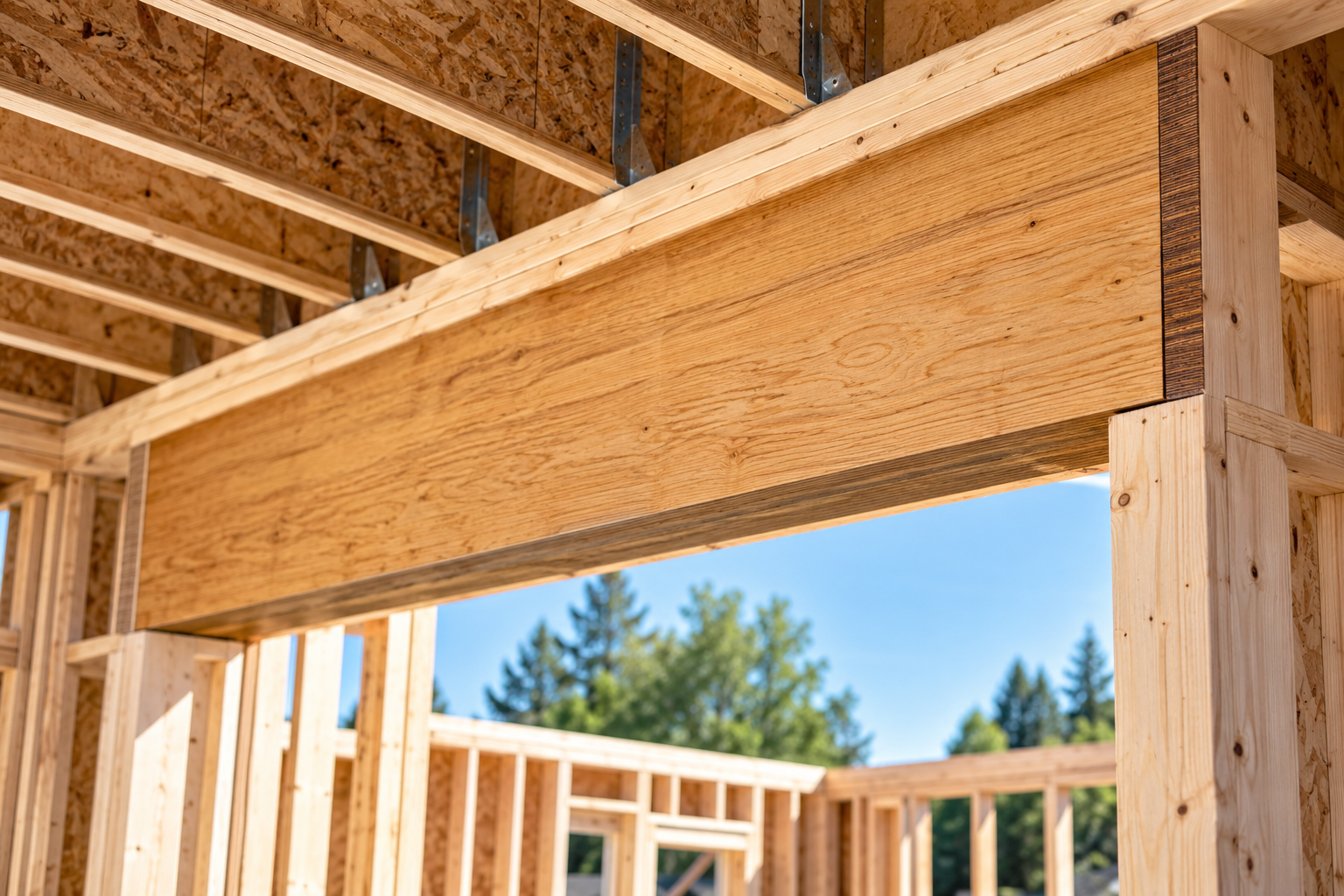
LVL starts with thin wood veneers bonded together with the grain running primarily in the same direction. APA classifies LVL within structural composite lumber, or SCL, and describes it as a product valued for predictable, uniform properties and consistent sizing.
Why LVL Fits Standard Framing So Well
That manufacturing method is a major reason LVL shows up so often in headers, multi-ply built-up beams, rim members, and framed conditions where installers want repeatable depth options and tight dimensional control. In the field, that veneer-based construction gives LVL the dimensional consistency needed where depth, alignment, and repeatability matter.
A contractor comparing LVL beam vs glulam is often really comparing a framing-oriented product that integrates easily into concealed assemblies against a larger-format timber product that may solve a different structural or architectural problem.
How Glulam Is Manufactured and Why It Is Used Differently
That framing logic changes once the project calls for a larger single-member beam, a longer clear span, or a member intended to remain visible. APA defines glulam as a stress-rated engineered wood beam made from sawn lumber laminations bonded with durable, moisture-resistant adhesives, with the grain running parallel to the length of the member.
Why Glulam Fits Longer Spans and Exposed Structure
Because those laminations can be arranged into larger and more varied member sizes, glulam is available in stock and custom dimensions and in multiple appearance classifications, including premium, architectural, industrial, and framing. The manufacturing split between laminated veneer lumber vs glulam helps explain why the two products often land in different parts of a project even when both satisfy the engineer’s demand for an engineered wood member.
LVL tends to fit narrow profiles, layered header build-ups, and conventional concealed framing details. Glulam tends to gain ground when the design needs longer clear spans, larger single-member geometry, camber control, or a finished wood appearance that is intended to stay visible.
LVL vs Glulam in Strength, Span, and Deflection
Structural comparison only helps when it stays tied to the actual member, span, and load case.
Strength Depends on the Member and the Load
Any discussion of glulam vs LVL strength becomes misleading when it skips over member size, span, loading, and allowable deflection. A shorter concealed header built from multiple plies of LVL may be the more efficient answer in a framed opening, while a larger glulam may be the better answer where the design calls for a long single-member span or a beam that remains visible below the roof or floor system.
Selection depends on how the required span, load path, depth limit, stiffness target, and connection strategy align with the approved design values and available member sizes for the specified product.
Deflection and Serviceability Affect the Finished Result
Those same span, loading, and size decisions also control how much movement a beam will show in service. Roof beams, long floor spans, and exposed members are often judged by how much they move and how that movement looks over time, not only by whether they meet minimum strength checks. APA’s glulam guidance also notes that glulam can be cambered to reduce the visible effect of dead-load deflection in long-span members.
Moisture Performance and Climate Exposure
Service conditions narrow the beam choice quickly, especially once the project moves beyond protected dry framing.
Where Standard LVL Fits in Protected Conditions
Standard LVL is commonly specified for protected structural use, and evaluation documents for treated and untreated LVL distinguish sharply between dry-service applications and unprotected wet-service exposure. ESR-2909 states that, except for Pacific Woodtech Treated LVL, applications in unprotected wet-service conditions where moisture content reaches 16 percent or greater are beyond the scope of the report. That matters in humid climates, delayed dry-in conditions, open porch assemblies, and other situations where repeated wetting is realistic.
What Changes When Glulam Faces Humidity or Wet-Service Risk
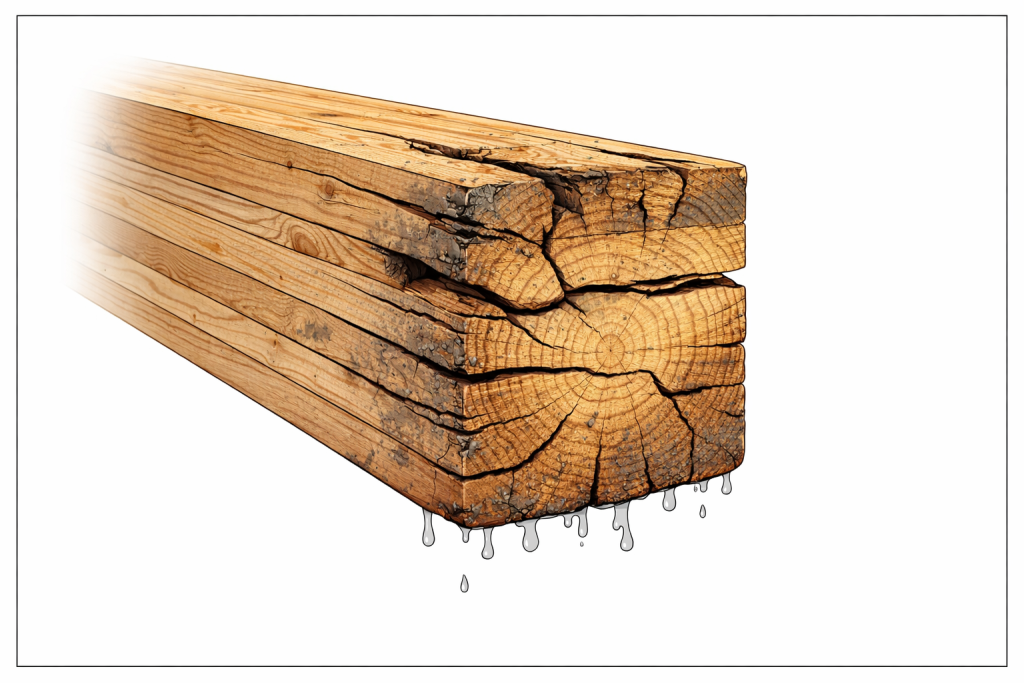
Once wet-service risk enters the specification, glulam has to be evaluated through treatment, storage, detailing, and service-environment fit rather than broad durability claims. APA notes that glulam uses durable, moisture-resistant adhesives, and it also identifies demanding commercial applications such as bridges, marinas, utility poles, and cross arms when members are manufactured and treated appropriately for those environments.
Treated LVL and Glulam for Exposure-Prone Conditions
Treated options also exist on both sides of the comparison, including pressure-treated or otherwise treated LVL products and treated glulam products. Those are product-specific solutions that have to be matched to the required use category, treatment standard, and manufacturer documentation rather than assumed from the general LVL or glulam label. Wet-service assumptions create expensive mistakes.
Why Covered and Exposure-Prone Conditions Still Need Different Specs
APA’s storage and handling guidance also makes the practical side clear. Glulam should be protected from poor storage conditions and rapid moisture swings, and APA says beam ends should be sealed whenever possible after trimming or cutting. A beam under deep roof cover is being asked to do something very different from a member at a breezeway, covered patio, or exterior-adjacent location, and that difference should be reflected in the specification before the beam is ordered.
Visible and Architectural Applications
Once service conditions are addressed, the next question is often whether the beam will remain visible in the finished assembly. Once the beam stays visible, finish quality and connection detailing start to affect the choice. LVL is usually easiest to justify where the beam will disappear behind finishes or within a framed assembly.
Glulam, by contrast, is manufactured and marketed with distinct appearance classes because exposed use is a core part of its value. That does not mean LVL cannot ever be exposed. It does mean exposed-beam work usually imposes a higher standard for surface quality, checking control, finish coordination, connection concealment, and visual uniformity than a concealed header line inside a wall.
Cost, Availability, and Procurement
For glulam beam vs LVL cost comparisons, material price and installed cost need to be separated before the numbers mean much. LVL often fits commodity framing workflows well because it is available in familiar header and beam sizes, can be built up in plies, and usually integrates into standard crew practices without requiring the job to be organized around a single oversized member. Glulam can still be economical when it replaces a more complex framing assembly or delivers a long span with a cleaner exposed result, but material cost alone rarely tells the whole story.
Three variables usually change the cost discussion fastest:
- Member format: Multi-ply LVL often works efficiently in standard framed openings, while larger single-piece glulam members can change labor and lift needs.
- Finished appearance: Exposed glulam may justify a higher install cost when it serves as both structure and visible finish.
- Availability and lead time: LVL is often easier to source in common framing sizes, while larger stock glulam or custom glulam members can require earlier procurement coordination.
Cost shifts again when the beam opens the room, removes intermediate supports, or remains visible as part of the finished structure. A glulam that reduces intermediate supports and serves as the finished ceiling expression may justify a higher procurement and install cost because it can consolidate structure and finish into one member. That is why LVL vs glulam should be judged against the full scope of labor, finishes, coordination, and procurement timing instead of a line-item material quote.
Installation Differences on Real Jobsites
This is where the specification decision starts to look like a labor and sequencing decision. LVL typically suits projects that rely on conventional framing crews, staged handling by several workers, and field adaptation around standard openings and bearing points. Manufacturers publish LVL beam and header guides with common framing sizes, bearing requirements, and load or deflection criteria because these members are routinely integrated into day-to-day framing practice.
Larger or exposed members change the install sequence. On a modest residential or light commercial job, LVL may arrive, get moved by a small crew, be cut to the required length, and be built into a header or beam line with standard framing tools and connectors, subject to the manufacturer’s limitations.
When glulam gets larger or stays visible, the jobsite usually has to plan around additional variables:
- Lift planning and delivery access become part of the beam decision, not just the install day.
- Storage protection and weather exposure matter more because the same member may remain visible in the finished structure.
- Staging and dry-in timing affect both labor flow and the risk of damage before enclosure.
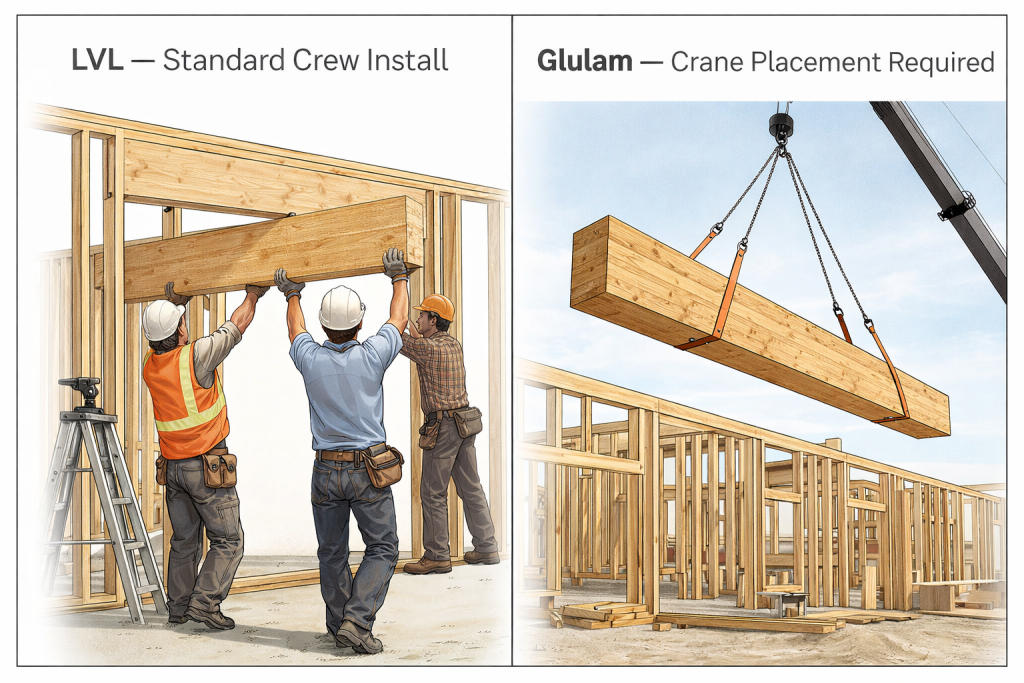
That shift is one of the clearest real-world differences between the two products.
Code Compliance, Span Tables, and Fire Design
Jobsite convenience still does not settle the beam choice. Code review matters because LVL vs glulam is ultimately governed by approved design values, evaluation reports, and the applicable code path rather than generic online advice. APA Product Reports document engineered wood products for conformance with applicable code provisions and recognized standards, while ICC-ES Evaluation Reports present the findings, conclusions, and recommendations from a technical evaluation of a building product.
The engineer or specifier still has to match the member to the project loads, service condition, connection design, and jurisdictional requirements. Span tables and manufacturer literature are part of the decision record, not optional reading. Fire design adds another layer when the member remains exposed, which is one reason glulam appears more often in heavy-timber and mass-timber structural conversations.
Choosing the Right Beam by Application
The beam choice gets clearer when the comparison is tied to the actual application.
- For headers and concealed framing: LVL vs glulam for headers usually tilts toward LVL because the member is concealed, the geometry is repetitive, and the framing crew benefits from a product designed around predictable depth and multi-ply build-up.
- For long spans and exposed beams: Glulam usually gains ground when the project needs larger single-member geometry, visible timber scale, or a finished structural element that remains part of the design.
- For humid or exposure-prone conditions: Standard interior LVL should not be assumed acceptable once the project moves into recurring wet-service exposure, and glulam should not be assumed ready for that environment without the right treatment, storage, detailing, and maintenance provisions.
Check those variables early against approved product data, and the beam choice usually becomes clear before avoidable cost and coordination problems reach the jobsite. That is where the right beam choice gets locked in.
Lock the Beam Choice Before Ordering
Confirm the selected member, connection assumptions, delivery method, and approval documents before ordering. Review manufacturer data and site logistics while the project can still adjust cleanly. Early coordination reduces field changes, lift delays, and specification conflicts later in framing. The right beam choice is not just a structural decision — it is a sequencing, specification, and coordination decision that affects everything downstream. Get it locked in before the order goes out, not after the crew is waiting at the site.
FAQ About LVL and Glulam
Is LVL stronger than glulam?
Neither is universally stronger in every application because the better choice depends on member size, span, loading, deflection limits, and the approved design values for the exact product being specified.
Which costs more, LVL or glulam?
LVL is often the lower-cost option in common framing uses, while glulam can become the more expensive choice once larger members, exposed-finish expectations, custom sizing, or added lift coordination enter the scope.
Can glulam be used outdoors?
Glulam can be used in exterior or high-humidity conditions when the member is manufactured, treated, detailed, and maintained for that service environment rather than assumed suitable by default.
Can LVL be used for exposed beams?
LVL can be left exposed in some projects, but glulam is usually the cleaner choice when the beam will remain visible because glulam is offered in appearance classifications intended for exposed finished use.
What does the building code say about choosing between LVL and glulam?
The code path does not choose one material over the other automatically, and the final selection still has to match approved design values, product documentation, service conditions, fire requirements, and the project’s structural calculations.