Roof framing choices keep affecting the project long after the sheathing goes on. The debate over roof trusses vs rafters changes span capability, attic use, insulation strategy, and the level of engineering review built into the project. On a real build, that decision also affects how the crew sequences the roof, how mechanical trades move through the attic, and how much flexibility remains once framing is in place.
Why the Choice Affects More Than Material Cost
The framing choice changes the load path, the amount of site labor, and how easily the roof can adapt to a custom plan. It also determines how much work gets done in the field versus in a plant. That is why a simple cost comparison rarely captures the real framing decision.
Both systems carry the same roof, but they do it through very different framing logic. Rafters rely on field layout, cut accuracy, bearing points, and the relationship between the roof slope and the ceiling framing. Trusses rely on a pre-engineered shape that spreads loads through chords and webs, which reduces field layout work but increases dependence on manufacturing, delivery timing, and installation coordination. The IRC requires truss design drawings before installation, while wood rafter sizing still ties back to span-table and load-based design tools.
How Rafters Work on a Real Build
Rafters are sloped framing members cut and installed on site. They bear at the exterior walls, tie into a ridge board or ridge beam depending on the design, and work with ceiling joists or rafter ties to control outward thrust where the roof assembly is framed conventionally. Because the members are cut in the field, rafters let the crew respond to irregular building shapes, dormers, intersecting roofs, and other details that do not fit a repetitive production pattern.
Rafters usually slow the crew down, but they give the field more room to work. A stick-framed roof gives the crew more freedom to build unusual roof lines, shift openings, or work around access limits on a tight site. It also asks more of the crew. Layout errors, inconsistent cuts, or poor bearing detail can create a roof that is harder to straighten and slower to sheath. When rafters are sized prescriptively, the decision still depends on span, spacing, species, grade, live load, dead load, and deflection limits, which is why rafter span tables still matter in real planning. Those variables are largely resolved in the field, member by member, as the roof takes shape.
How Engineered Roof Trusses Work
Trusses resolve many of those same structural questions before the roof package ever reaches the site. Their top chords, bottom chords, and internal webs are arranged so loads move through a defined geometry rather than through a single sloped member acting mostly in bending. That geometry is what allows engineered roof trusses to span farther, reduce intermediate bearing in many layouts, and arrive on site as repeatable components ready for placement.
That repeatable layout can make setting go fast, but it also tightens up what the field can change later. Trusses can frame a roof quickly once the package arrives and the setting sequence is organized, but the system works best when the design is coordinated early. Current IRC provisions require truss design drawings that identify key project data such as span, spacing, bearing widths, reactions, and design loads, and industry guidance treats the truss placement diagram as part of the submittal package identifying assumed truss locations. In practice, that means the roof becomes a reviewed package that has to match the building plan, the loading criteria, and the installed layout.
Structural Differences in Span, Loads, and Force Transfer
In roof trusses vs rafters, the stronger system is the one designed correctly for the span, geometry, and loading conditions in front of it. A properly designed truss can carry long spans efficiently because the web configuration redistributes forces through multiple members. A properly sized rafter system can also perform extremely well, especially on smaller or more customized roofs where the framing path is straightforward and the spans stay within prescriptive or engineered limits.
The structural split shows up in the load path. Rafters concentrate performance in the individual member size, spacing, bearing detail, and the way the roof assembly is tied together. Trusses distribute force through the whole assembly, which is why damage to a single web or chord matters so much. Regional loading changes the equation for both systems. Snow load, wind exposure, and seismic design category all sit inside residential design criteria, and FEMA guidance also emphasizes that uplift forces need a continuous load path from the roof assembly to the foundation. That same framing geometry also determines how much room is left below the roof.
Attic Space, Ceiling Shape, and Future Use
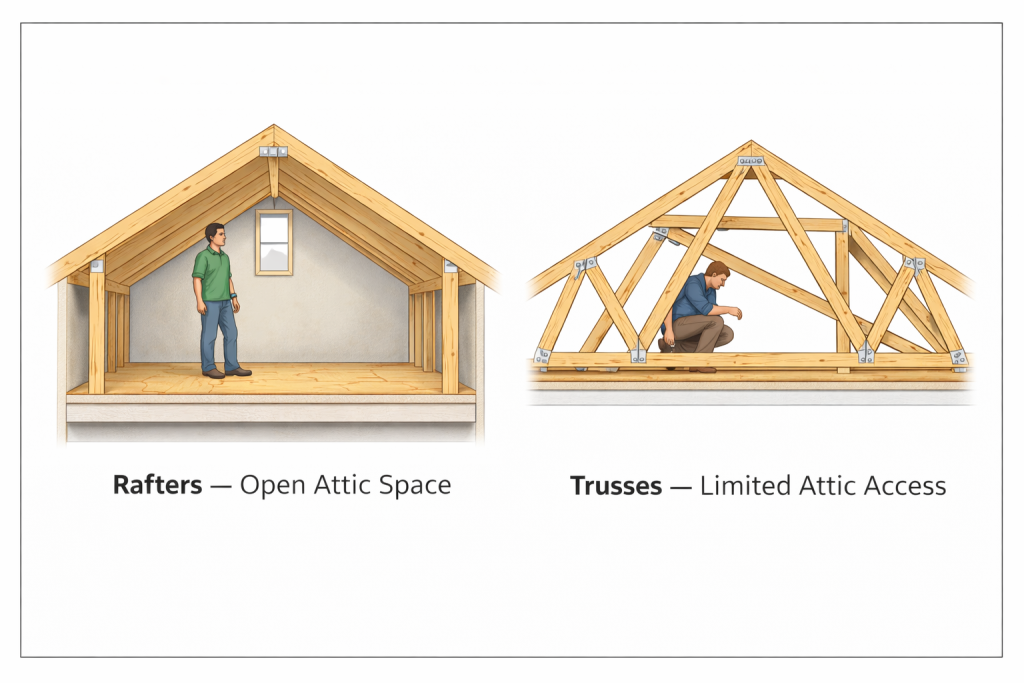
For plenty of projects, the question comes down to how much usable room the roof leaves behind. Rafters often leave more room because there is no web network crossing the attic, which makes them appealing when the owner wants storage, future conversion potential, or a cleaner vaulted or cathedral ceiling through the center of the house.
Standard trusses usually give up that open volume in exchange for framing efficiency and speed. That does not mean trusses eliminate design options. Industry configuration guidance shows that truss profiles can be varied widely, including vaulted and other special shapes, but those options need to be designed into the package before fabrication. A rafter-framed roof is usually more forgiving when the plan may evolve, while a trussed roof is usually more efficient when the geometry is already settled and the intended attic use is known in advance. That same roof profile also determines how much insulation depth remains available near the outside wall.
Energy Performance and Insulation Differences
Insulation performance often gets won or lost at the eaves. Rafters often make full-depth insulation easier to maintain because each bay can be framed with the roof depth and ventilation path in mind, especially on assemblies where the designer wants continuous depth from the field of the roof toward the outside wall.
Standard low-heel trusses can tighten that space near the edge of the building. When the top chord drops close to the exterior wall plate, insulation gets thinner exactly where the enclosure is already vulnerable. DOE-backed guidance states that raised-heel trusses allow full-height attic insulation to extend to the eaves, reducing cold spots at the top of exterior walls, and related DOE building-science guidance notes that high-R eave designs depend on preserving full insulation over the top plates of exterior walls.
A well-designed truss package can perform very well thermally, but the insulation strategy needs to be resolved early. That choice affects detailing, labor, and budget once the roof moves from drawings to field work.
Cost Differences Beyond Lumber Price
The roof trusses vs rafters cost discussion gets distorted when people compare lumber only. The real rafters vs trusses cost picture includes labor skill, fabrication lead time, delivery coordination, crane or boom access, wasted site time, and the cost of fixing mistakes when the roof package or the field layout does not match the plan. Material price still matters, but it rarely tells the whole story.
Rafters often shift more cost into skilled field labor because crews spend more time cutting, fitting, aligning, and adjusting members on site. Trusses often shift more cost into procurement and logistics because the package has to be designed, manufactured, shipped, staged, and sometimes lifted with rented equipment. Industry and manufacturer guidance consistently note that trusses are usually faster to install than rafters because they arrive prefabricated, while rafters take more time and field skill to build, especially on more complicated roof lines.
Installation Reality on the Jobsite
Those costs show up fast once the crew starts cutting rafters or setting trusses. Truss setting can move very quickly when the package is accurate, the delivery window is controlled, and the site can accept the lift. A crew can set and brace a large section of roof framing in a short period once the crane or boom is in place, which is one reason trusses are widely used on repeated roof plans and larger clear-span layouts. SBCA installation guidance also emphasizes that early restraint and bracing during truss erection are critical because the first set of trusses supports the stability of the rest of the installation.
Rafters spread the work across more cuts, more measurements, and more field judgment. That slows production, but it also gives the crew room to adapt. A rafter crew can build a complicated valley condition, frame a custom overbuild, or respond to irregular dimensions without waiting for a revised factory package. Weather and access also change the jobsite calculus. A truss job can gain time quickly on a good setting day, but a missed delivery or delayed lift can stall the roof. A rafter-framed roof usually moves more gradually, yet the crew retains more control when site conditions or sequencing shift.
Why Cutting a Truss Is a Serious Structural Problem
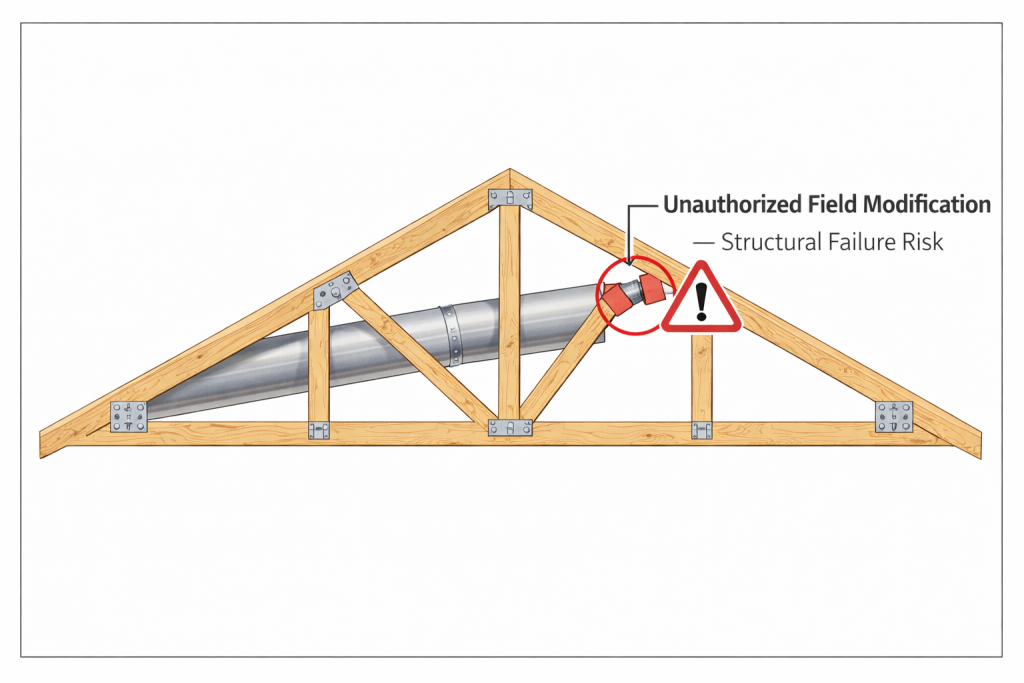
In roof trusses vs rafters, field modification is where the engineering difference becomes impossible to ignore. A cut truss creates a structural problem immediately. A truss is not just a bundle of lumber shaped like a triangle. It is a designed force path. The top chord, bottom chord, and webs each do a specific job. When a subcontractor cuts a web for ductwork, drills through a chord, or notches a member to clear a pipe, the truss is no longer carrying loads the way it was engineered to carry them.
That is why this issue is treated so seriously in code language and field practice. Code-oriented sources summarizing IRC truss requirements state that truss members and components are not to be cut, notched, drilled, spliced, or otherwise altered without registered design professional approval, and added loads also require verification that the truss can support them. This is not a paperwork technicality. It is the structural consequence of changing a system that depends on geometry and member interaction rather than on one oversized piece of lumber doing all the work alone.
A site-built rafter system can also be damaged by careless notching or boring, but a conventional framed roof is usually easier to understand and repair because the force path is less dependent on an engineered web network. A damaged truss often needs a repair detail prepared or approved by the design professional before the work can be corrected. Once that happens, the project moves out of informal jobsite judgment and into a documented review path.
Code Compliance and Engineered Drawings
That review path is one of the clearest differences between the two systems. Conventional rafters may fall under prescriptive sizing and span rules when the roof stays within the limits of the residential code and accepted span guidance. Trusses usually bring a separate submittal and review process based on the project loads, bearing conditions, spacing, and roof geometry shown in the permit set. The truss design drawings and the truss placement diagram are part of that workflow.
During plan review and inspection, the reviewer is matching the installed truss package against the permit set, the truss design drawings, and the stated loading criteria. In higher-wind regions, that review also ties directly into uplift-connection requirements because the roof framing has to transfer wind forces into the wall system through a continuous load path. Local snow load, wind exposure, seismic category, and site-specific climate criteria can all push the engineer or designer toward one framing approach, bracing requirement, or connection detail over another.
When to Use Rafters, When to Use Trusses, and When to Use Both
A roof trusses vs rafters decision should end with the framing method that fits the building, the crew, and the local loads. Rafters make the most sense when the roof is custom, when the design may still move, when attic openness matters, or when site access makes truss delivery and lifting harder to manage. They also make sense on projects where the builder wants more freedom to shape valleys, dormers, overbuilds, or future room-in-attic potential without redesigning a manufactured package.
Trusses make the most sense when the plan is settled, the roof geometry repeats, the spans reward engineered efficiency, and the schedule benefits from rapid setting. They are especially effective when the project can coordinate lead times, delivery, staging, and bracing in advance. They also work well when the design team wants engineered consistency across a large roof area instead of relying on a heavier field-built framing effort.
Some of the best projects use both. A house might use trusses across the main roof for speed and span efficiency, then shift to rafters over a porch, a complex intersecting entry, a bonus-room area, or a section where mechanical routing and ceiling shape need more field freedom. That hybrid approach usually fits the project better than forcing one system everywhere out of habit.
Plan the Right Roof Framing Strategy Before the Crew Starts
Sort out the framing plan before lumber is ordered or the truss package is released. Span demands, attic goals, insulation depth, site access, crane logistics, and field-change limits all affect whether rafters, trusses, or a hybrid layout will make the build go more smoothly. Make those calls early, or the job can end up paying for delays, redesign, and field fixes once framing is already moving. The framing choice affects more than material cost — it shapes how the whole build sequences, how the trades work through the roof, and how much flexibility remains when the plan changes.
Are roof trusses stronger than rafters?
Not by default. Trusses and rafters can both perform well when they are designed correctly for the span, loads, geometry, and connection details, although engineered trusses often handle long spans very efficiently because loads move through the full truss assembly rather than through a single sloped member.
Which is cheaper, trusses or rafters?
Trusses often reduce field labor on simple roofs, but the cheaper option depends on more than lumber price because crane access, delivery timing, manufacturing lead times, and custom roof complexity can change the total cost fast. Prefabricated trusses are commonly faster to install, while rafters usually require more site cutting and skilled labor.
Can I convert a trussed attic to living space?
Sometimes, but it is usually not a simple field change. Standard trusses are not the same as room-in-attic or specialty truss profiles, and any alteration to existing truss members needs design-professional review before the work can move forward.
What happens if a truss is cut or modified?
A cut truss can no longer be assumed to carry loads the way it was originally designed to carry them. Code-oriented sources summarizing IRC requirements state that truss members are not to be cut, drilled, notched, spliced, or otherwise altered without registered design professional approval, and added loads require capacity verification.
Do trusses require engineered drawings?
Yes. The IRC requires truss design drawings with project-specific information such as span, spacing, bearing, reactions, and design loads before installation, which is one reason trusses move through a different review path than conventionally framed rafters.